-
Building Bridges
Last Wednesday, yes, one of those days after we’d already had a considerable snow fall, myself and Gavin went on a walk with the support and guidance of a couple of the Walking for Health leaders, and some of the group members.Starting at Armstrongs Mill which is near to one of the former train station sites (Ilkeston Junction), we meandered along the canal path, down to Bennerley Viaduct – this is a historically important structure is Grade II Listed and is on the Buildings at Risk Register. Unusual for it’s time, it is a wrought iron lattice work structure, when most viaducts were brick built – because of former coal mining in the area, it was subject to a lot of subsidence and it meant the structure was lighter. If you want to read more about the Viaduct, click here – it will take you to the Wikipedia page about it, which is as good a start as any. Happy history hunting.Despite the cold air, and crunchy snow underfoot, it was a lovely day for the walk, and the light was simply beautiful. I opted to take my little camera with me for ease; I do wish I had taken my dSLR as my pocket camera tended to mess up on light settings, but hopefully you can get the idea of how lovely it looked:
Bennerley Viaduct 

 Well, I didn’t actually use the black and white setting here! The light was not quite as dramatic and stormy as it looks, but if I lighten the image any more, it loses all definition.It was fascinating for me; despite having lived in the area for most of my life, I don’t know that side of Ilkeston all that well, and lost my bearings a couple of times – it was good when I saw recognisable landmarks (to me) such as the Awsworth by-pass.The walk ended with a cuppa and tea-cake in Armstrongs Mill and a good chat with the walking group. Hopefully we’ll pick up some interesting memories about Stanton, and Cotmanhay, the railways, and so on, but mostly it was a pleasure to make contact with new people; certainly the walk inspired me to want to start sketching again (something I don’t do nearly enough of these days); now I actually know how to get down to the viaduct, I will return to with the bigger camera and the sketchbook – this might inspire a whole new body of work!
-
New Year, New Project…
Well, I should start this post by wishing you a happy new year!
Sorry I haven’t blogged for a while. I’ve been kinda busy. During December, I was really busy with the Erewash Festival of Light. I did lots of workshops in primary schools in the area; I made over 90 decorations for the young ones to decorate, and then I also prepared and helped design/decorate over 185 glass jar lanterns. That’s 185 jars to wash and de-label. 185 names to ensure written on. 185 cable ties to check tight and trim. 185 lengths of twist tie to cut… and a LOT of tissue paper, tracing paper and glass marker pens to prepare. I must have sounded like some raging alcholic every time I went anywhere with my bags of glass, clinking away…. cheers!
So, that, and a little thing called Christmas was how I saw the tail end of 2012. But new year, new project, and I am now moving on to the Metal Ages. This is part of a the two year long Excite Inspire Engage Erewash; inspired by local heritage, and supported by Arts Council England and Erewash Partnership, it will explore different art forms with a series of workshops and exhibitions.
I am collaborating with another Ilkeston based artist, Gavin Darby of Frailloop a sculptor who describes himself as “I am Gavin and I weld things”. Take a look at his website, you will see that in fact, he is so much more – he creates fabulous sculptures which are full of character from bits from cars, machinery and so on. As well as the workshops we’re going to be running, which will involve both metal and glass technniques, casting and bridge building, we are working towards producing two sculptures that will live permanently, one at the King George Gallery and another at Erewash Museum.
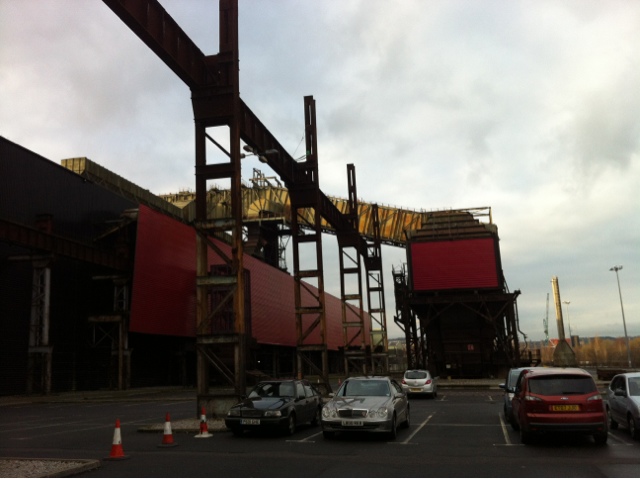
We recently took a visit to Magna, a former steel foundry in Rotheram, and will be looking at the former Stanton Ironworks site, Bennerly Viaduct, manhole covers and generally looking at the former thriving steel and iron industry that once was in the Erewash area.
I was really sensible when I sorted my camera out to take with me on the Magna visit. Put in new batteries, and recharged not one, but two spare sets. Feeling smug, knowing I wasn’t going to run out of ‘fire power’ I get out my camera, to find it said memory full… so all I could get was a few snaps on the iPhone…. ah well, I have my (metal) memories…


-
We Did It!!
It’s up!I’ve had a few sleepless nights lately, and yesterday I nearly wore a whole through the carpet in anticipation, although we were thwarted by the weather. All in the name of intalling the Olympic Legacy Wall at Kirk Hallam (KHCTSC)Today, the weather was a little kinder, and the rain held off. A few hairy moments when it was being lifted onto it’s brackets, as it’s so heavy, it’s there, and I think it looks rather good!I will come back later and post a more detailed account of the project and fill in any gaps from before, but I am just so excited, pleased (and relieved!) to see it up, I had to post this image – including scaffolding and humans to give you an idea of scale. It is placed around 3 metres up from the ground to the lower edge, glad I didn’t have to climb the scaffold tower!
The Olmypic Legacy Wall -
Workshops
 I updated my website just before I went away, but I forgot to share! I’ve pencilled in some new dates for glass fusing workshops at my studio in Derbyshire …NEW WORKSHOP DATES.
During my one day taster sessions, I will show you how to cut and handle glass safely; we practice with clear window glass first – most students create a small wall hanging in the morning, and later we move onto using Bullseye Glass – a brand of fusing glass that has the most gorgeous range of colours in sheet glass as well as ‘accessory’ glass such as frit and stringer, as well as using inclusions and other methods.
 I show you various methods of assembling coloured glass to produce a small range of glass pieces for pendants, brooches, cufflinks etc, or perhaps a coaster, as well as explaining a bit about the technical side of things – you’ll get some advice notes to take away, and I can talk you through related products such as kilns, cold-working equipment and so on.At the end of the day, your work is loaded into my digitally controlled glass kiln to be fired overnight – your work will be annealed for strength and durability, so the pieces you make are suitable for practical use either for yourself as as gifts for others.
 On a standard day, I do not show you now to make anything specific as I prefer to let you explore your own creativity whilst learning the new techniques, although I occasionally will be running themed workshops. Of course if there is anything special you’d like to make, then we can look at this too! Normal fusing days are for groups of 3 to 5 people, so lots of time to help you get things right. If a small group of people want a class tailoring to specifc needs, please get in touch and we can work this out.
 Prices for 2011 are only £50 per person, per day – this includes tuition, access to tools and equipment, firing costs, and supply of glass and accessories to make several pieces to keep.